

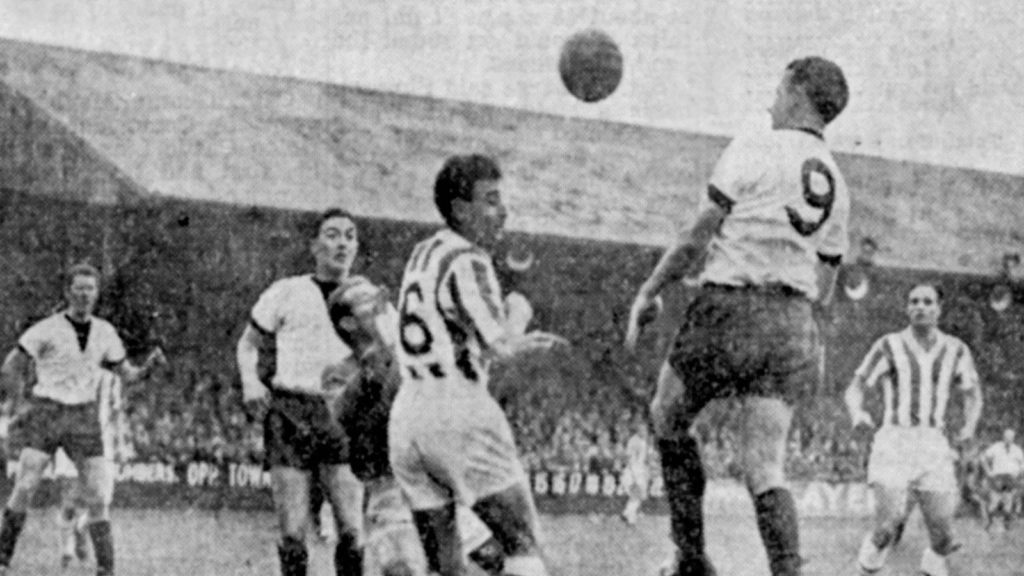
Heritage Number #662
Born in South Shields on May 6 1934, Ron Rafferty grew up in Burnham, 177 miles from the town he would later call home for six years. As a teenager, he turned out for local side Slough Centre before making the move to Isthmian League side Wycombe Wanderers at the age of 18.
Rafferty juggled national service with his footballing career during his time at Wycombe, but his commitments did little to limit his impact on the side. In his first and only season at Loakes Park, Rafferty scored 10 goals in just 14 matches. The impressive goal return attracted the attention of south coast side Portsmouth, who made a move for the striker in July 1954.
The £3,500 move offered Rafferty a chance to establish himself at the highest level of English football. However, opportunities proved limited at Fratton Park, where he made just 23 league appearances and scored five goals. By December 1956, he had moved on to Grimsby Town, where he would go on to leave a far greater mark.
His debut came in the January of 1957 in an FA Cup tie against West Ham, and with it so too came his first goal in black and white. Just three weeks later, his first league goal followed in a clash against Leicester City. From there, the striker never let up.
After joining in the second half of the season, Rafferty scored 11 league goals, instantly establishing himself as a top player at the side. One match reporter joked that he was so valuable to the Mariners that the side “would not let him go for all the Sputniks in Russia”.
His second season only cemented that value. In the 1957/58 season Grimsby finished 13th in the Second Division, scoring 86 goals in total. Rafferty’s 26 goals accounted for almost a third of them. For a side finishing mid-table, his contribution was remarkable, establishing him as one of the division’s most prolific goal scorers.
The following season brought a sharp reversal in fortunes. The Mariners slipped down to 21st in the Second Division, conceding 90 goals and winning just nine of their 42 league matches. Rafferty continued to deliver though, scoring 19 goals in 39 appearances, but his goals could not compensate for a defence that were struggling to meet the demands of the Second Division.
The frustration was evident before Christmas, when Town led Liverpool 2-0 with Rafferty scoring the goal to put his side ahead, only to lose 3-2 after conceding three times. As the season wore on, the goals dried up across the team. A seven-match run without scoring formed part of a poor late-season spell for the side, and Grimsby’s relegation was confirmed. For Rafferty, it was a setback, but not the end of his influence at the side.
In the Mariners’ first season back in the Third Division the side finished fourth with 52 points from 46 matches. The South Shields-born striker found himself leading a new strike partnership alongside Ralph Hunt, who had arrived from Derby County.
The pair proved devastating in the Third Division. Hunt scored 33 goals in 39 league appearances, while Rafferty added 24 from 46, their combined 57 goals accounted for almost two-thirds of Grimsby’s league goals. Grimsby scored 87 times across the campaign, finishing fourth and immediately establishing themselves as contenders for promotion.
The following season saw promotion elude the Blundell Park side once again, as they finished in sixth place. After a scintillating first season for the new-found partnership, Ralph suffered a serious injury, limiting him to just 14 league appearances. The side relied on Rafferty for their goal output once again, and again he delivered. The former Portsmouth striker finished the season with another 24 goals, achieving the same tally as the season before in a side that scored 10 fewer goals overall.
His consistency could not prevent the side sliding down the table though. Grimsby collected just five points from ten fixtures, finishing two places lower than the previous season. Another promotion opportunity had passed them by, but Rafferty’s importance to the side remained unmistakable. Even without Hunt beside him, he remained an ever dependable source of goals as the Mariners prepared for another attempt to return to the Second Division.
Rafferty’s penultimate season at Blundell Park started unusually slowly. After the first 11 rounds the striker sat on just three goals, but a hat-trick against Reading would lead to a remarkable turnaround. From October onwards, the striker went on a ludicrous run, scoring 30 goals in 31 matches. During January, February, and March, he found the net in ten consecutive starts. With this incredible feat, Grimsby lost just twice in 21 matches, climbing from mid-table into the promotion places.
His tally of 34 league goals saw Rafferty set a new club record for goals in a Third Division campaign, surpassing Hunt’s debut season tally. Rafferty was no longer just a consistent goalscorer, he was the driving force behind the club’s promotion back to the Second Division.
After the euphoria that followed promotion, Rafferty’s final season at Blundell Park was a difficult one. The Mariners’ talisman had undergone knee surgery ahead of the season, leading to a sharp decline in his output. He scored eight goals in the league as Grimsby finished 19th in the Second Division, his final goal came in April 1963 against Walsall.
In July 1963 Rafferty joined Hull City for £10,000 ending a six and a half year stay at Blundell Park. By the time he left he had recorded 152 goals across 277 appearances, a staggering achievement that places him amongst the club’s top all-time goalscorers. From the Second Division struggles, to the side’s re-promotion, Rafferty’s goals remained a constant.
UTM

