Heritage Number #660
Referred to by Cod Almighty as one of the most skilful players in Grimsby history, Johnny Scott arrived at Blundell Park in June 1956 with a point to prove.
Born in Belfast on 22nd December 1933, Scott had spent the early years of his career at Manchester United under manager Matt Busby. Opportunities at United had proved limited, but a move to the Mariners would mark the beginning of the most significant chapter in his playing career.
Scott had joined Manchester United in October 1951 after attracting the attention of scout Bob Bishop while playing youth football in Belfast. He found himself among a remarkable generation of young talent, later referred to as ‘the Busby Babes’, including the likes of Bobby Charlton. Opportunities in the first team setup proved scarce for the young winger, as he managed just three appearances before departing to Blundell Park in pursuit of a new opportunity in 1956.
The move saw him reunited with Allenby Chilton, the player-manager for the Mariners and a former Manchester United teammate who was acutely aware of the ability that Scott possessed. Chilton’s faith in the 23-year-old was promptly rewarded. On August 25th 1956, Scott made his Grimsby debut against Notts County at Blundell Park, scoring the winner in a 2-1 victory. It was a debut that offered an early glimpse of the player who would go on to become one of the club’s most entertaining talents.
Fast, comfortable on either foot and blessed with exceptional close control, he was a player who aimed to beat his man and deliver the ball into dangerous areas. His ability to operate anywhere across the final third and his reputation as a penalty specialist only made him more valuable to the side. Journalist Charles Ekberg, dubbed Scott “one of the finest ball-players in the second division”, high praise for a player who had previously struggled for game time.
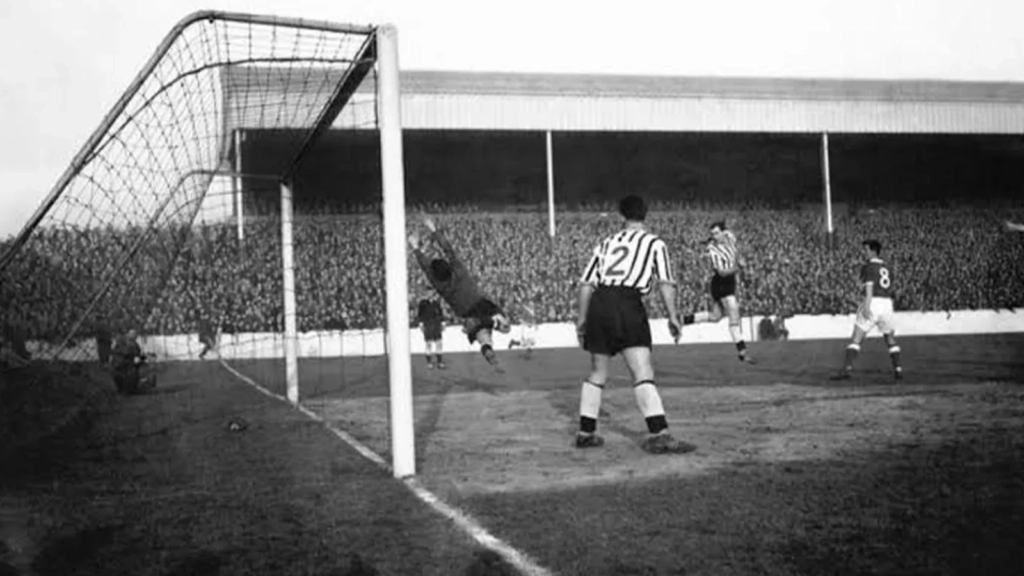
Scott quickly struck up a potent partnership with centre-forward Ron Rafferty. Contemporary match reports regularly highlighted the winger’s ability to beat his marker and deliver the final ball, with Rafferty often the intended target. While assists were not officially recorded, surviving match reports paint a vivid picture of a partnership that was the driving force of a well-oiled Mariners attack. Recalling a 4-4 draw with Lincoln City in September 1958, author Anthony Suter remembered the “three times Scott found Rafferty’s head, and from it the back of the net.” A contemporary report from the meeting with Sheffield United at Bramall Lane that December also recorded Rafferty scoring from Scott’s corner. Together, these accounts illustrate how effectively Scott turned his individual skill into a tool to facilitate the rest of the side.
His performances also carried him onto football’s biggest stage. In the summer of 1958, Scott travelled to Sweden with Northern Ireland for the World Cup, becoming the only player in Grimsby Town history to appear at the tournament’s finals. Making his international debut against Czechoslovakia, he helped his country secure a 2-1 victory after extra time before starting the subsequent 4-0 quarter-final defeat to France. For a player who had struggled for opportunities just two years earlier, it was a remarkable achievement.
Yet Scott’s significance to Grimsby extended far beyond that international milestone. Across seven seasons, he became a firm favourite at Blundell Park, remembered for the anticipation his feints, close control and crosses generated among supporters. His return from Sweden brought an immediate reminder of his influence: he scored in a 3-3 draw at Liverpool before finding the net twice against Lincoln City in front of 22,261 spectators.
These were more than isolated flashes of brilliance. Scott remained with the Mariners through relegation and two near-misses, continuing to contribute as the club sought to regain its Second Division status. His story was not simply that of a gifted winger who briefly reached the international stage, but of a player whose best years were intertwined with Grimsby’s efforts to re-establish itself.
That persistence was rewarded in 1961/62, when Town secured promotion back to the Second Division. In the decisive 2-0 victory at Brentford, Scott’s free-kick led to Cliff Portwood’s opener before Rafferty sealed the win. His contribution to the promotion campaign gave his Grimsby career a fitting high point, bringing him a tangible achievement to match the individual moments of brilliance that had made him such a popular figure.
Scott departed for York City in 1963 having scored 51 league goals in 241 appearances for Grimsby. Those figures capture his longevity and attacking contribution, but cannot fully convey the excitement he brought to Blundell Park. For seven seasons, he gave supporters a player capable of turning a match with a moment of skill, while helping deliver the promotion that restored the Mariners to the Second Division.
UTM