

Heritage Number #
Born on September 8th, 1969, in Middlesbrough, Steve ‘Livvo’ Livingstone, the son of professional footballer Joe Livingstone, began his footballing journey by joining Coventry City’s youth setup at the age of 16. Just a year later, he made the step up to the senior side, going on to make 31 league appearances over the following five years.
While he struggled to make a regular impact at Highfield Road, a £450,000 move to Blackburn Rovers in 1991 proved far more fruitful. In his first season, he scored nine league goals in 18 appearances, seven of which came in his first ten outings. The following campaign saw Livingstone and his teammates secure a return to the top flight via the play-offs, although concerns surrounding the striker’s fitness meant opportunities under Kenny Dalglish became increasingly limited.
After just two Premier League appearances, Chelsea made a £350,000 move for the 23-year-old. His first and only competitive appearance for the London club came in a 3-0 defeat against Manchester United towards the end of the 1992/93 campaign.
The following season began with a month-long loan spell at Port Vale, where he made five appearances without finding the net.
By October 1993, having made just one competitive appearance for Chelsea, Livingstone was approaching a crossroads in his career. At 24, regular first-team football was becoming increasingly important, and a move away from London offered the chance to get his career back on track.
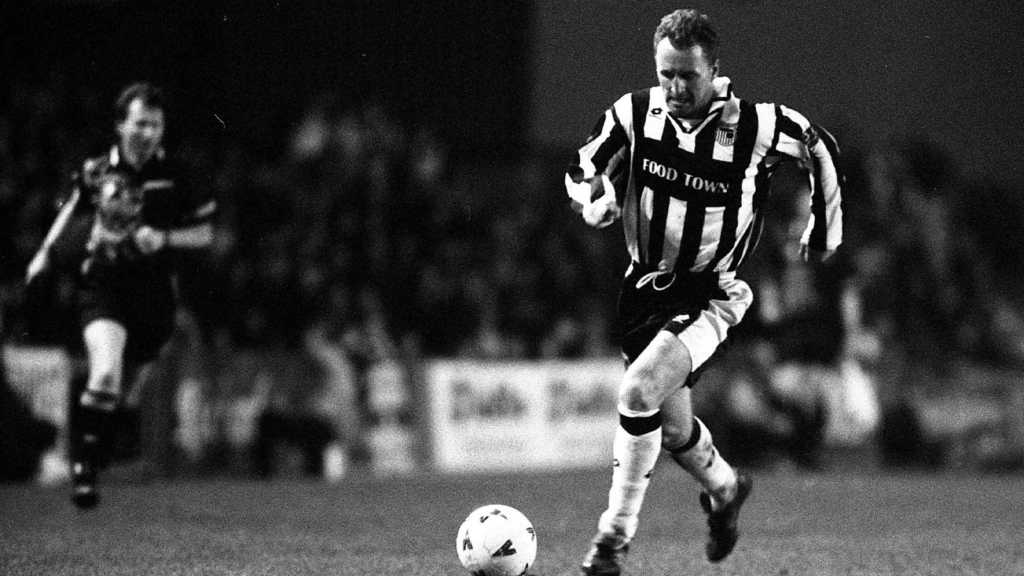
That opportunity arrived at Blundell Park. Initially joining Grimsby on loan, Livingstone quickly made the move permanent, with the Mariners agreeing a reported £140,000 fee for his services on October 29, 1993. Few could have anticipated quite how significant that decision would prove, with the Middlesbrough-born forward going on to spend the next decade on the Humber.
Upon joining the Mariners, ‘Livvo’ made an almost immediate impact with both the supporters and manager Alan Buckley, making 27 appearances and scoring three goals in the First Division. His physical presence and willingness to put himself about quickly made him a useful option in the Grimsby forward line, while his work rate endeared him to a support that valued players prepared to give everything for the shirt.
Early into the Middlesbrough-born striker’s second season, Alan Buckley was replaced by Brian Laws, but Livingstone’s importance to the side remained undiminished. He made 34 league appearances and scored eight goals, a marked improvement on the previous season’s tally, as the Mariners finished 10th in the First Division.
Despite a 17th-place finish for the Mariners, the 1995/96 campaign proved to be a career-best season for Steve Livingstone in front of goal. He finished as the club’s joint-top league goalscorer alongside Paul Groves, with both players reaching double figures on ten goals. A further three strikes in cup competitions saw the 26-year-old finish the campaign with 13 goals in all competitions. The tally demonstrated that Livingstone was more than just a physical presence in the final third; he was equally capable of providing a consistent goal threat.
The 1996/97 campaign proved a difficult one for both Livingstone and the Mariners. Having finished 17th the previous season, Grimsby struggled for consistency and, despite the forward contributing six league goals in 32 appearances, the club’s three-year stay in the First Division came to an end. Town finished 22nd, four points adrift of safety, with Livingstone making 34 appearances in all competitions. The following summer, however, brought a familiar face back to Blundell Park, with Alan Buckley returning to take charge
With a rebuild on the card, Buckley bought in Kevin Donovan, David Smith and Paul Groves, who had joined Buckley at West Bromwich Albion for the previous campaign. With various changes to the squad, Livingstone remained just as important. The striker scored twice against Fulham to secure the side’s first win of the season after a difficult start. He continued to contribute with goals against Oldham Athletic, Sheffield Wednesday, and League Cup holders Leicester City in a run that saw the Mariners make the fourth round of the League Cup.
The League Cup run was far from the end though, Livingstone and the Mariners were crowned champions of the Auto Windscreens Shield (now the EFL Trophy) and had secured a spot in the promotion play-offs. With a second Wembley appearance in five weeks, the side secured their promotion back to the First Division with a 1-0 win against Northampton in the final.
Following the celebrations of the previous campaign, Grimsby returned to the First Division with a respectable 11th-place finish, comfortably establishing themselves back in the second tier. However, for Livingstone, the 1998/99 season brought a significant change in responsibility. Having spent much of his Grimsby career leading the forward line, Alan Buckley increasingly began utilising the Middlesbrough-born player in central defence. His physical presence and aerial ability offered a different dimension to the Mariners’ backline, with the 29-year-old making 24 league appearances across the campaign. Although his days as a regular goalscorer had temporarily come to an end, Livingstone’s importance to the side remained, demonstrating a willingness to put the team’s needs ahead of his own position.
Having finished 11th the previous season, the Mariners endured a significant regression in 1999/2000, eventually finishing 20th in the First Division, narrowly avoiding relegation. Livingstone continued to be utilised primarily in central defence, having adapted to the unfamiliar role under Alan Buckley. However, he still demonstrated that his attacking instincts had not deserted him, scoring twice in a 3-2 victory over Stockport County in the FA Cup third round. Despite the memorable cup contribution, his time further forward remained limited, and the following season would eventually bring a welcome change in fortunes for the 30-year-old.
The 2000/01 campaign brought a welcome change for Livingstone, with Lennie Lawrence returning him to the forward line after almost two seasons in defence. It was a move that appeared to reinvigorate the 30-year-old, who rediscovered his enjoyment of the game and became an important attacking option for the Mariners once again. Speaking in December 2000, Livingstone admitted that his time at the back had begun to take its toll, revealing: “I’m enjoying it more than I have for the last two or three years, and I’m looking forward to games more. It’s been a new lease of life.”
Unfortunately, the following seasons brought further difficulties. Circulation problems in his calves restricted him to just three appearances in 2001/02, before a fractured skull sustained in a collision with Danny Higginbotham during a visit to Derby County in August 2002 threatened to bring his playing career to an abrupt end. The injury kept him out for several weeks, but Livingstone’s determination to return was evident even during his recovery. Manager Paul Groves spoke of the importance he held within the dressing room, describing him as one of the “strong people who the others lean on for support”.
After a decade at Blundell Park, Livingstone eventually departed in the summer of 2003, with Grimsby having been relegated from the First Division. His departure marked the end of a remarkable association, spanning promotion, relegation, two Wembley victories and countless battles in between. Reflecting on his time on the Humber, he offered a fitting explanation for the connection he had developed with the club and its supporters: “It was us against the world and that was the Grimsby attitude that I loved.”
UTM

