

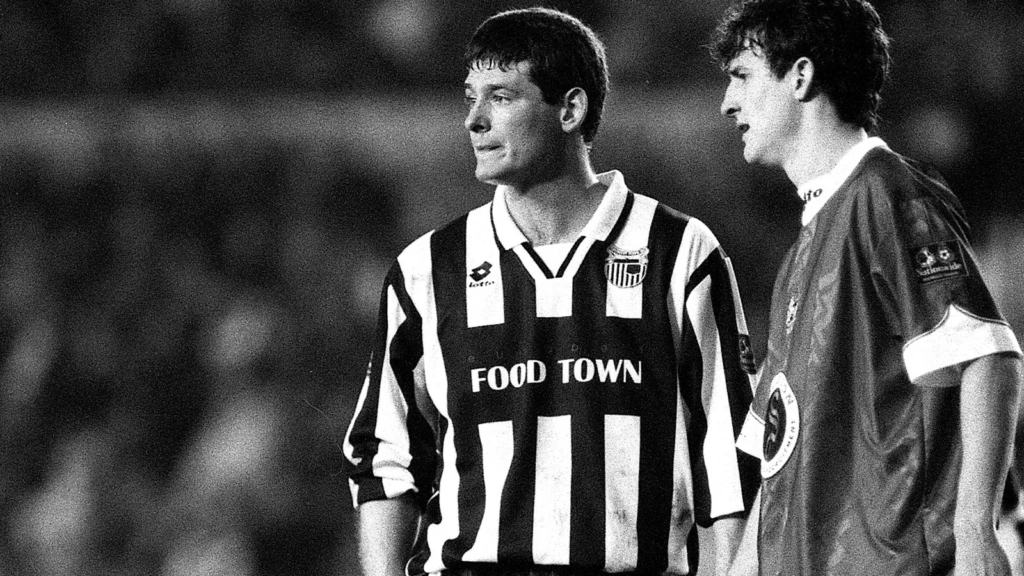
On March 12th 1991, the Mariners travelled to Millmoor and delivered one of the most emphatic performances of their promotion-winning campaign, sweeping aside Rotherham United in a 4-1 victory. Tony Rees struck twice, with Neil Woods also getting on the scoresheet as Alan Buckley’s side continued their pursuit of a second successive promotion.
Born in Merthyr Tydfil on August 1st 1964, Tony Rees’ professional football career began with a spell at Aston Villa as a teenager, before making the switch to Birmingham City at the age of 19. The Welsh forward spent five years at the Midlands side before moving to Barnsley in March 1988.
His time at Barnsley proved relatively brief, a year later and he was on the move again. On 17th August 1989, Rees signed for Grimsby. It marked the beginning of a five-year stay with the Mariners, during which he would go on to make 141 league appearances, scoring 33 goals.
Neil Woods’ route to Grimsby had taken him considerably further afield. Having begun his professional career at Doncaster Rovers, the young forward attracted attention from Scotland, joining Rangers in December 1986 for a fee of £120,000. Just three appearances followed before a move back to England with Ipswich Town, where he would spend the next three seasons.
A brief spell at Bradford City brought him back to the Second Division, before he joined Alan Buckley’s Grimsby Town in August 1990. The 24-year-old wasted no time making a first impression, scoring eight goals in his first 12 appearances and beginning a partnership with Tony Rees that would become an important feature of Grimsby’s side in the seasons to come.
Their styles of play were almost perfectly complementary. Rees was a creative influence for the attack, with teammate John McDermott recalling that “everything we did went through him”. Woods, meanwhile, was known for his intelligence and technical ability, capable of bringing his teammates into the game at a moment’s notice.
The 1990/91 campaign provided the first major reward for their developing understanding. Rees contributed 10 league goals, with Woods adding 12 more as Grimsby won a second consecutive promotion under Alan Buckley. Their combined goal tally represented exactly a third of the sides’ goal haul for the season, a staggering figure that goes to show how effective their partnership had come in such a short space of time.
Whilst the following season presented a sterner challenge for Buckley’s side, Rees and Woods’ partnership remained a defining feature of the side, scoring 13 of the side’s 47 Second Division goals that year, as the Mariners finished clear of the relegation zone in 19th.
The 1992/93 campaign offered further evidence of the duo’s importance. Following a league restructuring, Grimsby finished ninth in the newly named First Division with 64 points. Rees made 31 league appearances and scored five goals, while Woods featured 30 times and found the net on four occasions.
Their final season together was less productive individually. As Grimsby’s fortunes improved, so too did the competition for places, with Buckley steadily expanding his attacking options. Clive Mendonca, Tony Daws, Mark Smith, and Murray Jones were among those who had recently been added to the squad. Shortly after Steve Livingstone’s move from Chelsea had been made permanent.
Chris Hargreaves described a fierce competition between players that accompanied the club’s rise through the divisions. For Rees and Woods, the 1993/94 campaign consequently brought a marked reduction in first-team involvement, with their combined league appearances falling from 61 to 27.
Rees’ Grimsby career came to an end in November 1984, following Alan Buckley’s departure to West Bromwich Albion in October. He followed his manager to the Hawthorns, where he spent the remainder of his Football League career, before returning to Wales with Merthyr Tydfil.
Woods, meanwhile, remained at Blundell Park, with his best individual campaign yet to come. The 1994/95 season saw him register 14 league goals. Although his involvement diminished in subsequent seasons, he remained a Mariner until 1998. Spells at York City, Southport, and Gainsborough Trinity followed before his playing career came to an end.
His connection with Grimsby remained in place long after his departure as a player, though. A return in 2003 as head of youth development, followed by a spell in charge of the first team, before returning to the academy.
While their paths ultimately diverged, their time playing together had coincided with a transformative time in Grimsby’s history in which their formidable partnership had played a pivotal role.
UTM

