Heritage Number #507
When Grimsby Town made their return to the First Division in 1934, they did so with a goalkeeper who had only made his Football League debut less than two years earlier.
George Tweedy joined the Mariners in July 1932 at just 19 years old, initially as understudy to established number one Tommy Read. But goalkeeper was not always his position. Growing up in the mining town of Willington, Tweedy had initially played centre-forward before taking his place between the posts for his hometown club.
Read had been Grimsby’s first choice since 1928, but a broken finger gave Tweedy his opportunity in a 1-1 draw against Bradford in November 1932.
Upon recovering, Tommy Read returned to the starting line-up and remained the club’s first choice throughout the following season, playing 30 matches as Grimsby won the Second Division title. His final appearance came in a 7-0 victory over Blackpool in April 1934.
Ahead of their first season back in the top-flight, Womack had a decision to make. The Grimsby manager opted to hand the number one spot to the now 21-year-old Tweedy.
Tweedy’s first full season as Grimsby’s starting keeper would hardly have given Womack reason to question his decision. The Mariners finished fifth in Division One in 1934/35, their highest league position in the club’s history, with Tweedy playing in all 42 league matches. The Mariners had the third best defensive record that season, conceding 60 goals.
He was later described by Grimsby historian Pat Bell as “almost faultless”, with his judgement and positioning praised alongside his ability to make “stupendous saves”. He could catch balls beneath his crossbar and clear them to halfway “as though it were a single fluid motion”.
The following season Grimsby slipped to 17th, losing 16 of their 21 away matches, but the FA Cup offered Tweedy a very different stage. Grimsby cast aside Hartlepool United and Port Vale before beating Manchester City 3-2 at Blundell Park and Middlesbrough 3-1 in the quarter-finals. For the first time in the club’s history, the Mariners had reached the FA Cup semi-finals.
Arsenal stood between Grimsby and a place in the final. The semi-final was played at Huddersfield’s Leeds Road, with 63,210 supporters packed inside the ground. Cliff Bastin’s goal five minutes before half-time proved to be enough to send Arsenal through to the final, but less than four years after arriving at Blundell Park as a 19-year-old understudy, Tweedy had taken his side to an FA Cup semi-final.
Despite the defeat, the run had helped establish Tweedy among the country’s top goalkeepers. A contemporary assessment of the season described Grimsby as “always a pleasing side”, while identifying Tweedy and Harry Betmead as “the mainstay of the other ranks”.
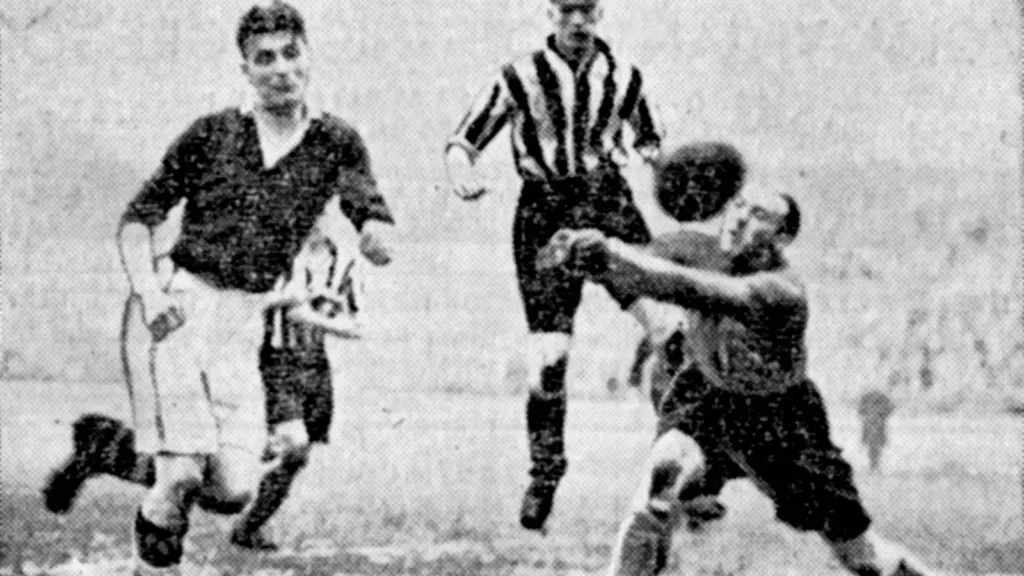
This wouldn’t be the last recognition Tweedy would receive that year. After helping his side beat Manchester United 6-2 at Blundell Park in November, he would take his place between the sticks at Highbury for England, becoming just the second of three Mariners to play for the Three Lions.
His England debut got off to a dream start as they took the lead through Eric Brook after 25 minutes before Hungary quickly equalised, but Ted Drake restored the advantage just seven minutes later. Drake added another before half-time, giving England a 3-1 lead at the interval. Hungary pulled another goal back early in the second half, but from there on England didn’t put a foot wrong, giving George Tweedy his second 6-2 victory in just over two weeks.
For Tweedy, it was the biggest individual honour of his career. The 23-year-old had gone from making his Mariners debut as an emergency replacement for Tommy Read four years earlier to representing his nation.
It would, however, prove to be his only England appearance. Despite that, Tweedy’s performances had left some wondering why further opportunities never arrived. As Pat Bell later wrote: “it was not just Grimbarians who thought he deserved many more.”
Tweedy remained Grimsby’s first choice over the following two seasons, with the Mariners spending their final years in the First Division before the outbreak of the Second World War. On 11 March 1939, he played in a 5-1 defeat at Chelsea, his final league appearance before another FA Cup semi-final later that month.
But with Grimsby preparing for their semi-final against Wolverhampton Wanderers on 25 March, Tweedy fell ill. He had been struck down with flu in the days before the game, leaving George Moulson to make his debut in front of a record 76,962 crowd.
For a goalkeeper regarded by many as Grimsby’s best ever, it was a cruel way to miss such an important game. Moulson’s afternoon lasted only 20 minutes. The goalkeeper was injured in a collision with Wolves forward Dick Dorsett and, with substitutes not permitted for injuries, Jack Hodgson was forced to take over in goal. Grimsby were left with ten men and an outfield player between the posts as Wolves went on to win 5-0. A result that will likely have left many wondering what could have happened had their number one not missed out.
The Second World War would soon bring a much longer interruption to Tweedy’s career. He continued playing for Grimsby during the early years of the war before making guest appearances for Arsenal and Hibernian, due to wartime stationing.
When competitive football made a full return after the war, so did Tweedy. He returned back home to Blundell Park and continued playing for the Mariners before eventually moving into coaching, becoming assistant manager in 1950.
By then, the goalkeeper who had once waited behind Tommy Read for his opportunity was now helping decide who would take the gloves for Grimsby. Tweedy was involved in bringing Stan Hayhurst to Blundell Park from Barrow, with Hayhurst going on to become the Mariners’ first-choice goalkeeper.
Almost two decades after arriving at Grimsby as a 19-year-old understudy, Tweedy was now the man helping to choose his successor for the next generation of Mariners.
George Tweedy’s time at Grimsby Town was a story of patience, opportunity and extraordinary achievement, and one that deserves to be remembered among the great goalkeeping stories in the club’s history.
UTM