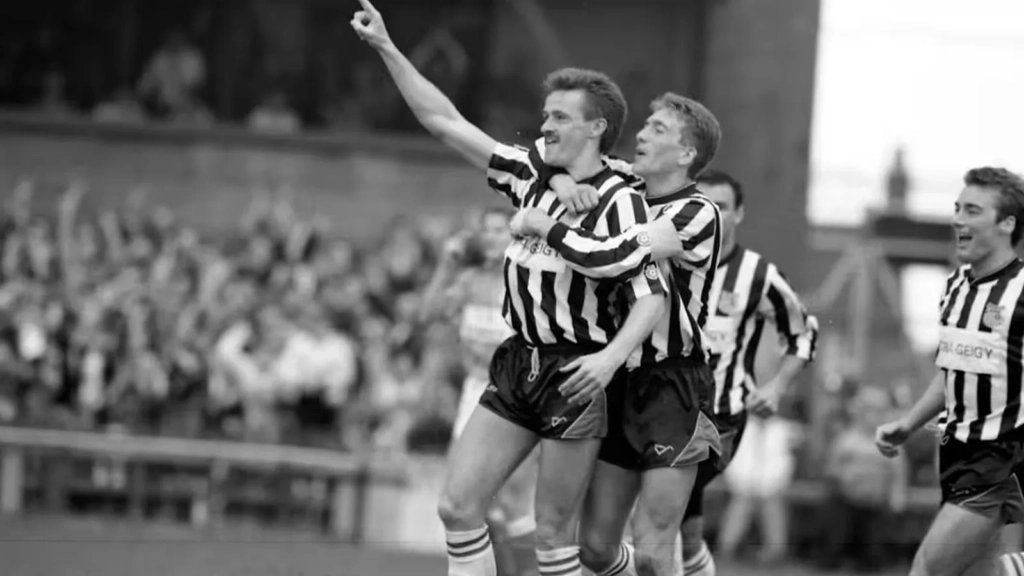
A football club can be remembered in many ways. Through the goals scored, the trophies won, the players who became legends. But there is another way of measuring a club’s history, one that is less obvious until the same names begin appearing again and again.
At Grimsby Town, several names have done exactly that.
The connection between the Moore family and the Mariners began in the years following the Second World War. Norman Moore made his debut in 1946, making seven appearances before moving to Hull City a year later. His brother Roy also represented the club, making three appearances.
It was Roy’s sons who would turn that family connection into something much more significant.
Kevin, David and Andy Moore went on to make more than 600 league appearances for Grimsby between them. Kevin accounted for the majority, making more than 400 appearances across an eleven-year spell at the club between 1976 and 1987. The centre-back helped the Mariners secure successive promotions and captained the side to two League Cup quarter-finals before later establishing himself in the top flight with Oldham Athletic and Southampton.
David followed a different path, but one that would ultimately keep him connected to the club for even longer. He made 140 league appearances across two spells and was part of the 1979/80 promotion-winning side alongside his brother. After retiring as a player, he returned as a youth-team coach before becoming the club’s first-team physiotherapist, a position he held until the end of the 2024/25 season.
Andy completed the trio, making 65 league appearances between 1983 and 1987 before spells with Lincoln City and Shamrock Rovers.
From Norman’s debut in 1946 to the end of David’s time as physiotherapist, the Moore family’s association with Town stretched across 78 years.
Their story was not the only one to span generations.
The Bloomer family’s connection with Grimsby crossed three generations. Jimmy Bloomer senior, a prolific striker, spent six years at the club between 1949 and 1955, making 109 league appearances and scoring 42 goals. His most productive campaign came in 1951/52, when his 18 goals helped Town finish second in Division Three, three points behind the champions.
More than a decade later, his son Jimmy junior followed him to Blundell Park, making 52 league appearances between 1964 and 1969. Almost thirty years after that, the family name appeared in Town’s first team once again. Having progressed through the club’s youth setup, Jimmy senior’s grandson Matt made 21 appearances before later working under the legendary Alan Buckley at Lincoln City.
For the Donovans, the connection between father and son would eventually stretch from Blundell Park to the summit of European football.
Don Donovan arrived from Everton in 1958 for a fee somewhere in the region of £5,000 and went on to make 238 appearances during his six year stay with the Mariners. The Ireland international later became manager of Boston United, where he won three consecutive league titles.
His son Terry, also an Ireland international, made his Town debut nearly two decades later. Between 1976 and 1979, he scored 28 goals in 75 league appearances before moving to Aston Villa. Three years later, he was part of the Villa side that lifted the European Cup.
The Cockerill family provides another example of the same connection. Ron arrived at Grimsby in 1958 and made almost 300 league appearances during the following decade. Thirty years later, his son John made 107 appearances between 1988 and 1991 before returning to Town in coaching and assistant-management roles. His brother Glenn also enjoyed a lengthy professional career, although away from Blundell Park.
At Grimsby Town, family names have repeatedly returned to Blundell Park, sometimes decades after they first appeared. For the Moores, that connection lasted almost eight decades and extended from the pitch to behind the scenes. For the Bloomers, it crossed three generations. For the Donovans, it ultimately reached the summit of European football.
Their stories stretch across different eras, from post-war football to recent seasons. In a club shaped by its history and community, their stories are a reminder that the history of a football club is built by the people and families who continue to give it meaning, both on and off the pitch.
UTM